Kawarau Gorge And The Jet Boat Ride: What Is And Is Not On The Route
The Kawarau Gorge is the dramatic middle stretch of the Kawarau River, but no Queenstown jet boat operator publishes a turn-by-turn route. Here is what the stated geography and the operators' own words actually tell you.
Short answer
The Kawarau River runs about 60 km from Lake Wakatipu to Lake Dunstan, and the gorge section carries the Kawarau Gorge Suspension Bridge, 43 m above the water. KJet and Thunder Jet both name the Kawarau River among their waterways, and RealNZ uses a jet boat as the transfer leg of a raft-led trip. No operator publishes which parts of the river a ride covers.
The Kawarau Gorge is one of the most photographed stretches of water in the Otago region, a steep-walled cut in schist country that State Highway 6 follows between Queenstown and Cromwell. Search for it and you will find bungy bridges, wine country and gold-mining history, and somewhere in the results a jet boat. The connection is real but looser than most visitors assume: Queenstown's jet boat operators launch from the town itself, and none of them publishes a route map or a promise that your ride will travel the gorge stretch. What follows sets out what the stated geography says, what each operator's own listing actually names, and what to ask before you book if the gorge itself is the reason you are booking.
What Exactly Is The Kawarau Gorge?
The Kawarau Gorge is the confined middle section of the Kawarau River, the stretch where the water cuts between steep rock walls on its roughly 60 km run from Lake Wakatipu, via the Frankton Arm, down to Lake Dunstan. The river's name is usually translated as "channel between rocks or shoals", which neatly describes this narrow passage.
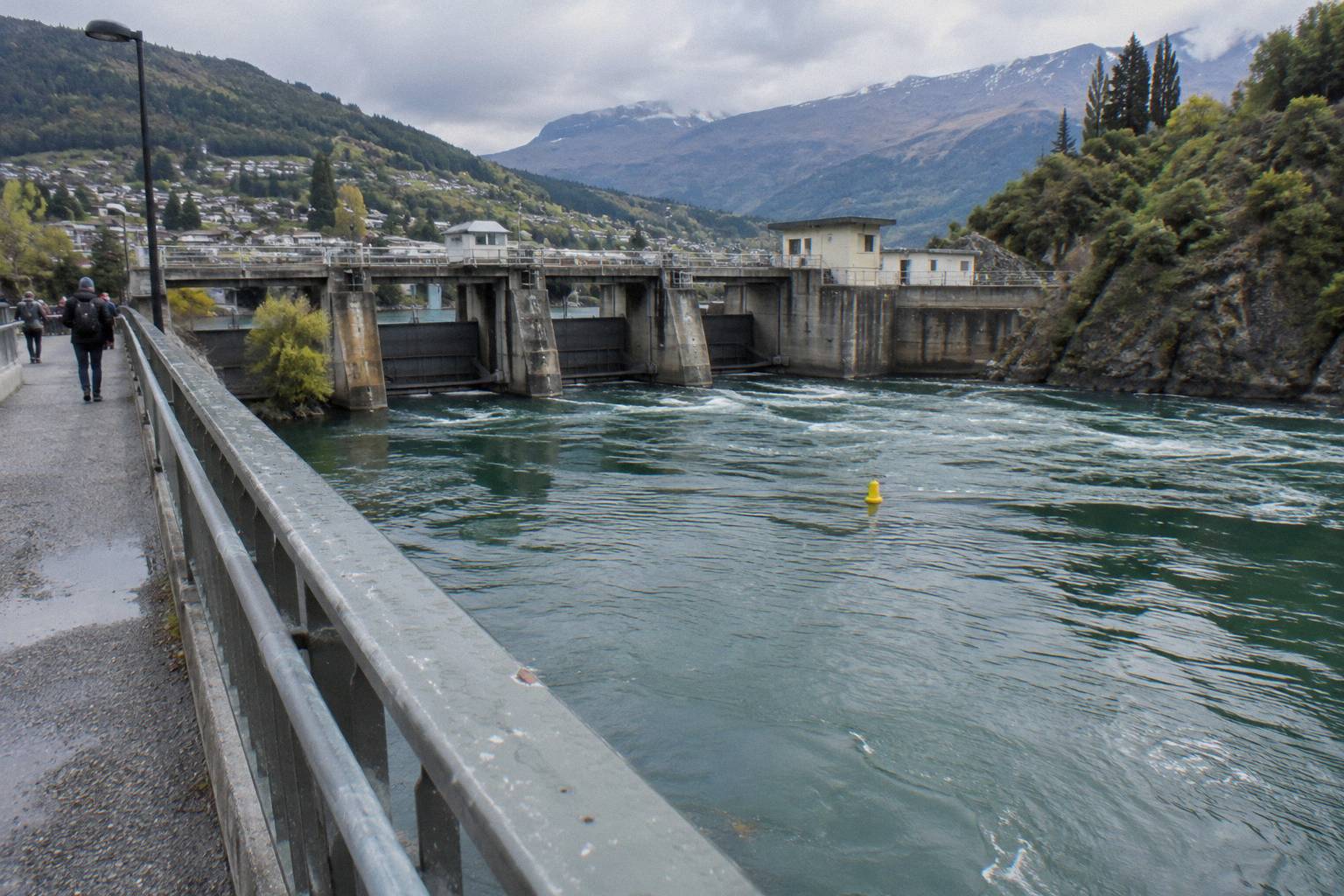
The river begins where Lake Wakatipu drains out, about 8 km east of Queenstown at the Frankton Arm, and the gates there have regulated the outlet since the 1920s. From that outlet the Kawarau builds volume fast, joined within a few kilometres by the Shotover, and it is by most measures a serious river: the largest-volume river commercially rafted in New Zealand. The stretch most people picture when they say "Kawarau Gorge" is downstream of the confluence country, where the valley narrows and the highway clings to the wall above the water.
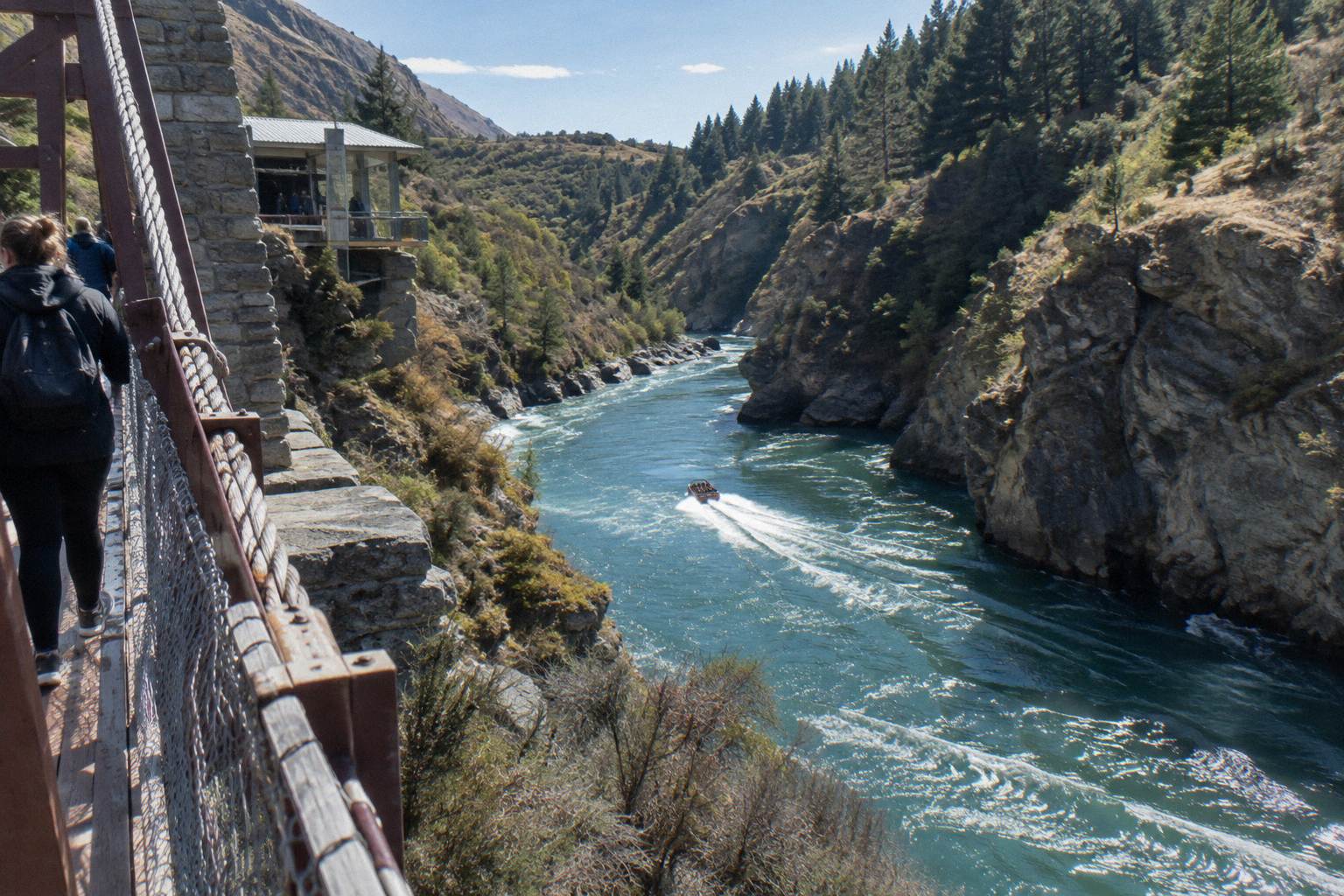
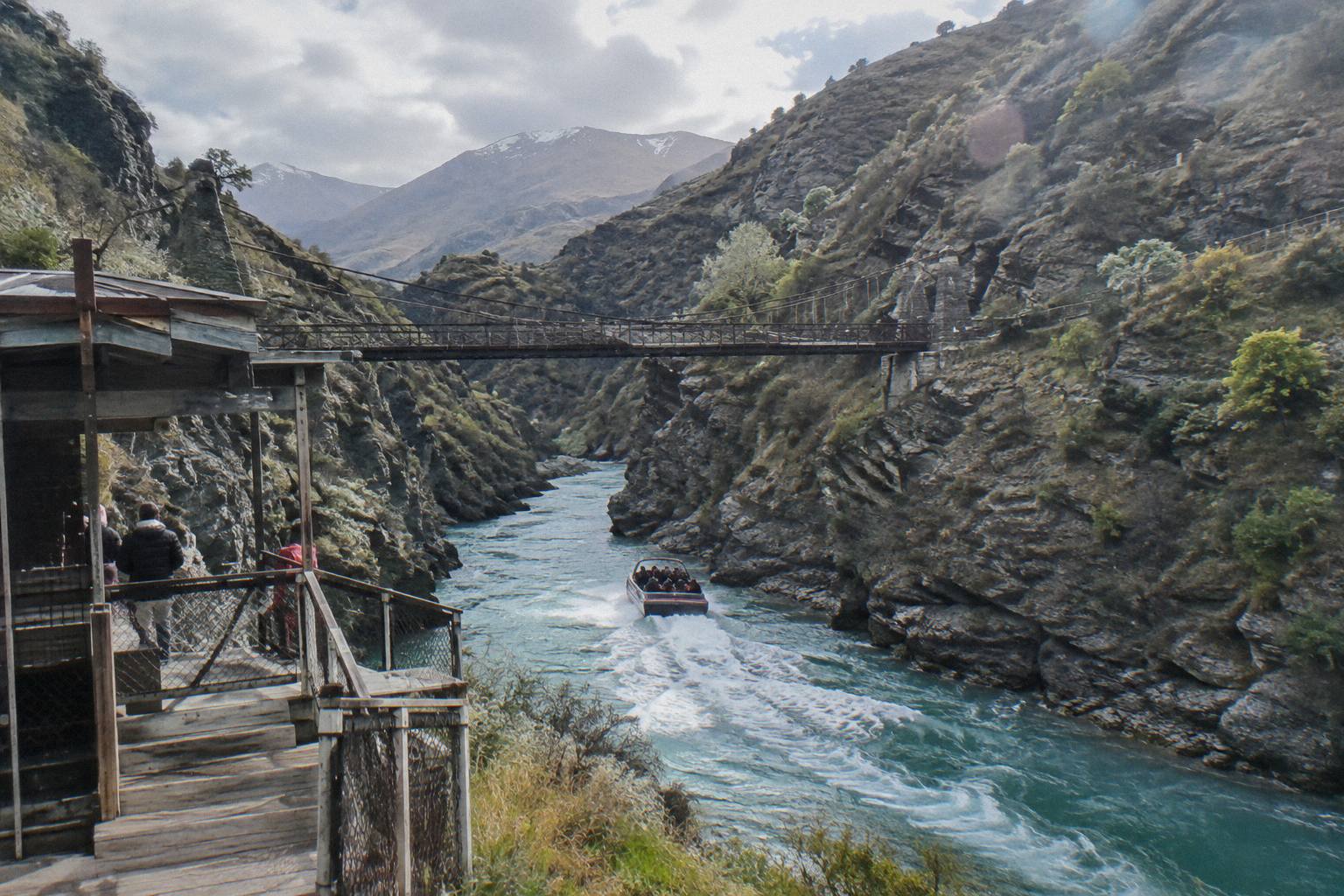
Two landmarks anchor the gorge in the public imagination. The first is the Kawarau Gorge Suspension Bridge, completed in late 1880, standing 43 m above the river: it is the site AJ Hackett describes as the world's first commercial bungy jumping operation, which is why so many gorge searches return bungy results rather than jet boat results. The second is the wine country around Gibbston, where the river slows through a wider, sunnier valley floor. Neither landmark is a jet boat departure point. If you want a fuller picture of the river's geography from the water's perspective, the companion guide to the Kawarau River from a jet boat covers the whole catchment in more detail.
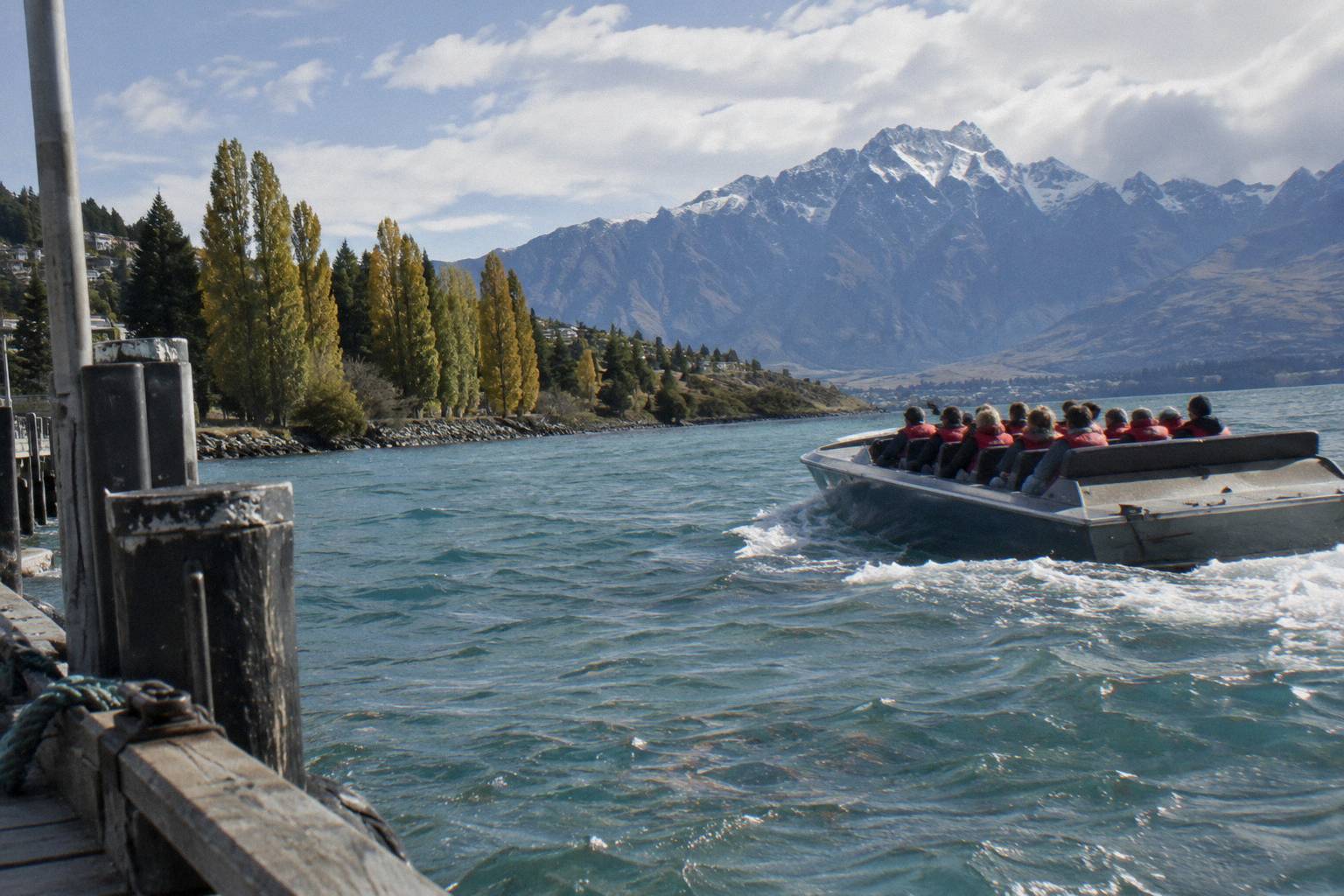
The practical point for a planner is this: "Kawarau Gorge" describes geography, not a product. The gorge sits roughly between Queenstown and Cromwell, while every jet boat trip sold from Queenstown Bay departs from the lakefront piers and wharves of the town itself. The distance between the departure points and the landmark gorge is not covered by any published jet boat route, and that gap is the single most common misunderstanding in this corner of Queenstown planning.
Does A Jet Boat Ride Actually Go Through The Gorge?
No operator publishes a route for any jet boat ride, so there is no verified answer, and none is invented here. KJet names three waterways for its 60-minute ride, Lake Wakatipu, the Kawarau River and the Shotover River, without publishing the order, length or extent. Thunder Jet names Lake Wakatipu and the Kawarau River for both its rides. Naming a river is not the same as naming a stretch of it.
- Thunder Jet 30-Minute RideNZ$119
- KJet 60-Minute RideNZ$159
- Thunder Jet 1-Hour RideNZ$159
This is the limit of the available information, and it applies to every operator equally. A booking page that lists "the Kawarau River" tells you the ride touches that river; it does not tell you whether you will pass under the suspension bridge, reach the Gibbston valley, or stay within sight of the lake outlet. Route lengths, water depths and turn-around points are simply not published by any of these operators, and any article that describes "the route" in loving turn-by-turn detail is filling the gap with imagination. The scope rule here is strict: state the waterways named, state the geography, and stop.
What the stated geography does support is a floor, not a ceiling. The Kawarau begins at the lake outlet about 8 km east of Queenstown, and the lower river runs about 60 km in total to Lake Dunstan. A one-hour ride that reaches the Kawarau at all must, by geography alone, be working the stretch of the river closest to the lake, where the mouth sits relative to the Queenstown Bay departure points. Whether a given hour on the water goes further downstream than that is exactly what you should ask the operator before booking, and the checklist below gives you the questions to use.
There is also a regulatory clue that is genuinely useful. The Queenstown Lakes District Council's navigation rules lift the national 5-knot nearshore speed limit on the "Kawarau River from Lake Whakatipu to the Arrow River confluence" all year, excluding a buoyed area near the Zoological Gardens. That uplifted stretch is the zone where commercial jet boating at speed is lawful, and its upper boundary, the Arrow River confluence, sits well upstream of the suspension bridge and the heart of the landmark gorge. An uplift is not a route, but it does show which part of the river the rules contemplate for this activity. The council's jet boating rules page states the wording in full.
Which Queenstown Rides Name The Kawarau River?
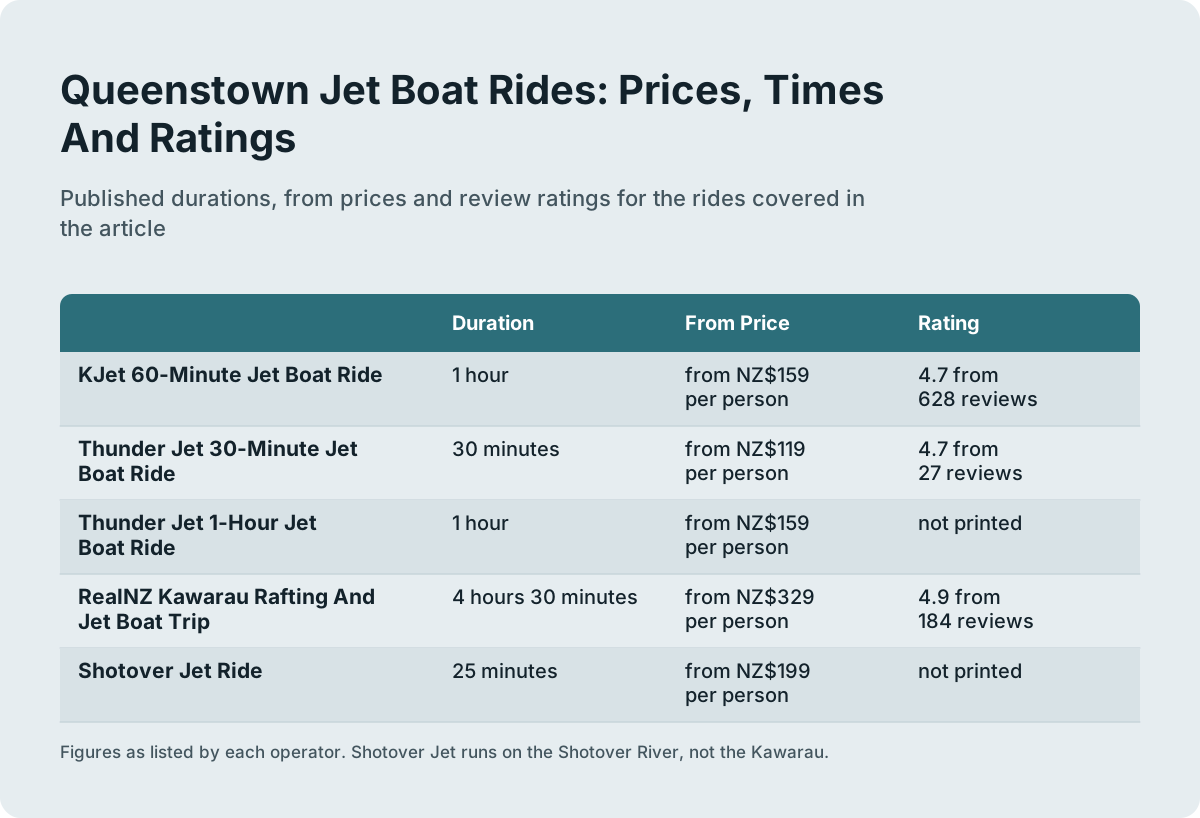
Three Queenstown products name the Kawarau River: the KJet 60-Minute Jet Boat Ride from the Main Town Pier (from NZ$159 per person, 4.7 from 628 reviews, 1 hour), both Thunder Jet rides from Steamer Wharf (from NZ$119 for 30 minutes or from NZ$159 for 1 hour), and the RealNZ raft trip, which includes a jet boat leg of about 25 minutes to the rafting put-in. The Shotover Jet Ride runs on a different river.
The table below holds every published figure available, in New Zealand dollars. Note what the two Thunder Jet listings are: one operator, one base, two lengths of a single product family. KJet has 628 reviews on its booking page.
| Ride | Operator | Waterways named | Duration | From price | Rating |
|---|---|---|---|---|---|
| KJet 60-Minute Jet Boat Ride | KJet | Lake Wakatipu, Kawarau River, Shotover River | 1 hour | from NZ$159 per person | 4.7 from 628 reviews |
| Thunder Jet 30-Minute Jet Boat Ride | Thunder Jet | Lake Wakatipu, Kawarau River | 30 minutes | from NZ$119 per person | 4.7 from 27 reviews |
| Thunder Jet 1-Hour Jet Boat Ride | Thunder Jet | Lake Wakatipu, Kawarau River | 1 hour | from NZ$159 per person | n/a |
| RealNZ Kawarau Rafting And Jet Boat Trip | RealNZ | Kawarau River (jet leg is the transfer) | 4 hours 30 minutes | from NZ$329 per person | 4.9 from 184 reviews |
| Shotover Jet Ride | Shotover Jet | Shotover River | 25 minutes | from NZ$199 per person | n/a |
KJet's listing is the one that names three waterways, which means its 60-minute ride is the only product that publicly claims both the Kawarau and the Shotover among its waters. KJet says boats leave every hour on the hour from 10am to 6pm, 365 days a year, weather permitting, from the Main Town Pier on Marine Parade; a version of about 40 minutes also leaves from the Queenstown Marina in Frankton. If seeing as many rivers as possible in one hour is the goal, that is the stated fact that matters, and the internal guide to KJet's pier route and ride works through the departure logistics.
The RealNZ product deserves careful framing because it is easy to misread. It is a raft-led trip of about 4.5 hours: the jet boat ride of about 25 minutes is how you reach the rafting put-in, and then you spend about an hour rafting the Kawarau itself. If your interest is the river rather than jet boating as an activity, this is the trip that puts the most time on the Kawarau water by far, with a wetsuit, equipment, hot showers, snacks and a round-trip transfer from the RealNZ Visitor Centre at 88 Beach Street included. The age rule is 13 and over, with 13 to 15 year olds needing a guardian, and a weight range of 40 kg to 120 kg applies. The companion piece on jet boat and rafting combos on the Kawarau compares the formats at length.
Where The Speed Uplift Tells You Jet Boating Happens
The council's navigation rules lift the 5-knot nearshore limit on the Kawarau from Lake Whakatipu to the Arrow River confluence, all year, except a buoyed zone near the Zoological Gardens, and on the Lower Shotover from the Kawarau confluence up to the Oxenbridge Tunnel, with a permit required in the concession area. These uplifts mark the water where fast jet boating is lawful; they do not describe any operator's route.
The national rule caps speed at 5 knots within 200 m of shore on all district rivers, and the uplifts are the exceptions written for the commercial and recreational jet boating these waterways carry. Read the geography of the Kawarau uplift and you get a free lesson in where the activity concentrates: the zone begins at the lake and ends at the Arrow River confluence, which sits in the Cromwell-side gorge country. Everything a Queenstown jet boat does at speed on the Kawarau, by law, happens within that band of the river.
Safety oversight runs alongside the speed rules. Under Maritime Rules Part 82, commercial river jet boat drivers must hold a New Zealand Commercial Jet Driver (River) Licence and meet the competency requirements of the operation, Maritime NZ inspects boats and safety equipment and audits operations, and a Commercial Jet Boat Operator Certificate must be displayed prominently at the operation. The Maritime NZ rules page carries the detail. When you arrive at any jet boat base in the district, that certificate on the wall is the visible end of an inspection and licensing system most passengers never think about. The longer guide to jet boat safety rules and licences in Queenstown unpacks what it means for a passenger.
The Gorge Landmarks You Will Not Reach By Jet Boat
The Kawarau Gorge Suspension Bridge, completed in late 1880 and 43 m above the river, sits in the gorge stretch downstream of the Arrow confluence country, and no Queenstown jet boat product claims it. Gibbston's wine country and the bungy operation are reached by road, about a drive along State Highway 6, not by any listed ride. Treat them as a separate half of your day.
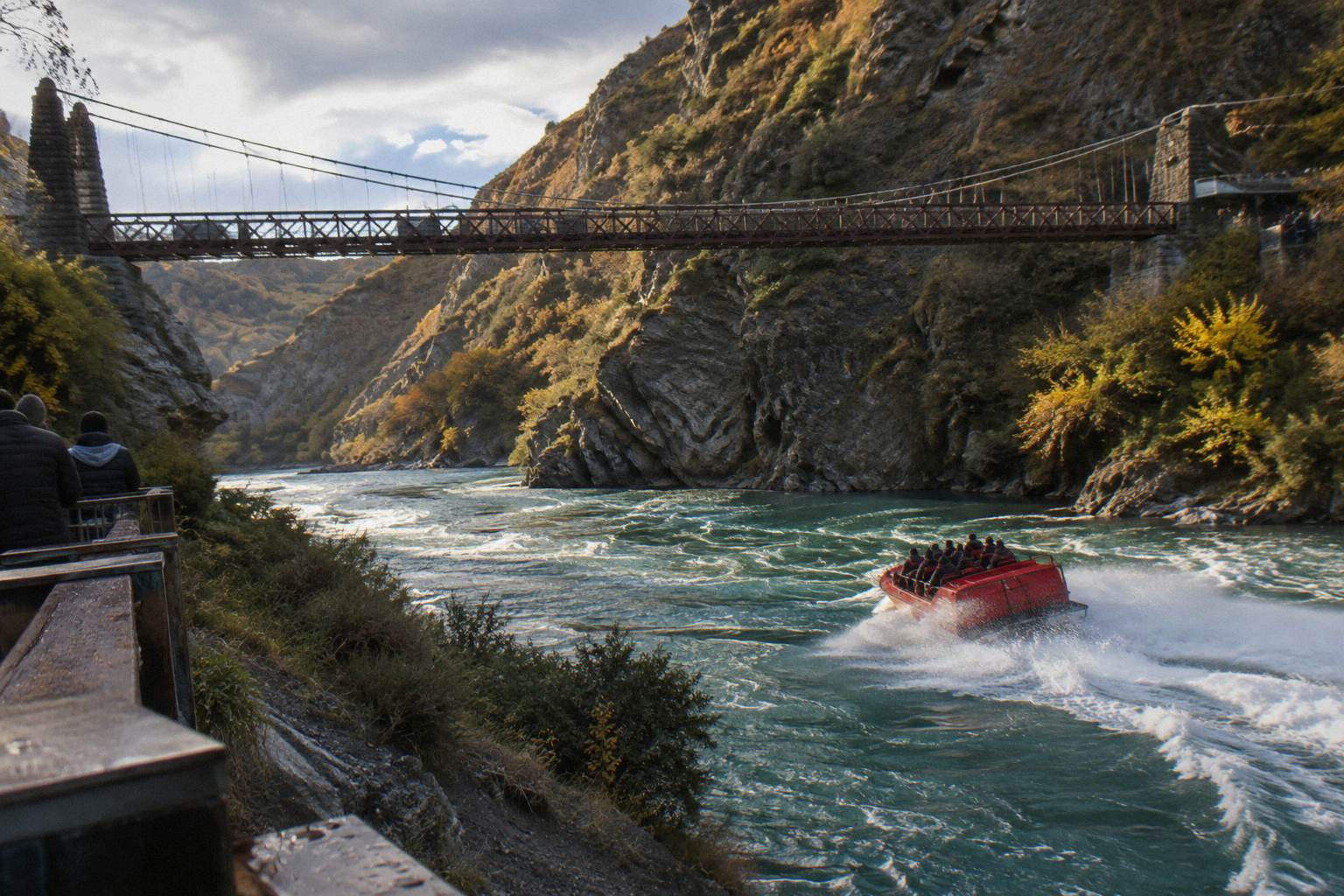
This is where a little planning pays off. If the suspension bridge, the bungy viewing deck or the Gibbston cellar doors are the images that brought you to the word "gorge", a jet boat from Queenstown Bay is not the vehicle for them. The bridge is an AJ Hackett site, described by the company as the world's first commercial bungy jumping site, and it works as a road-trip stop or a bungy booking in its own right. Plenty of visitors build a day that pairs a morning jet boat from the town pier with an afternoon drive into the gorge, and the guide to a jet boat and bungy day in Queenstown lays out how the two bookings fit together.
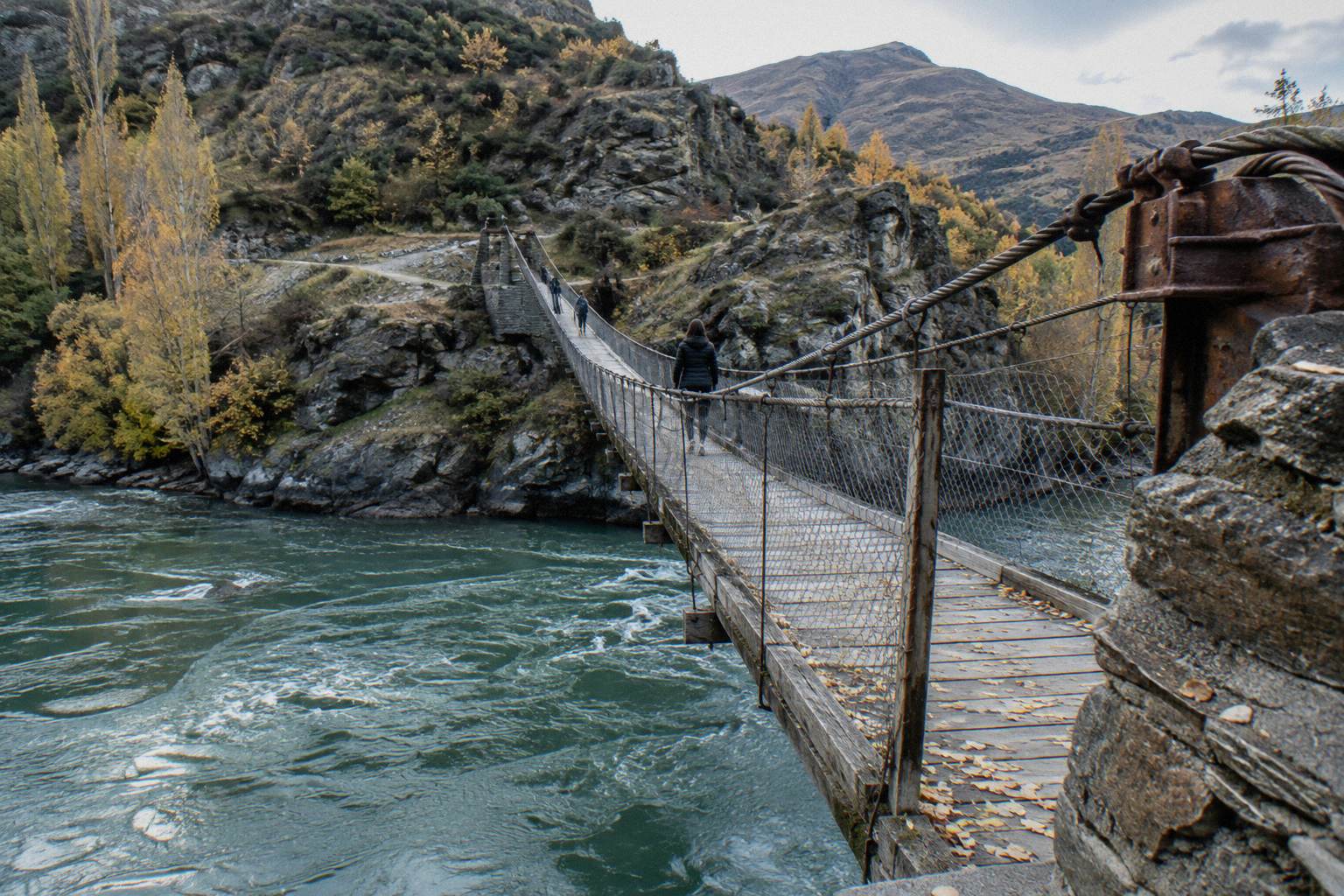
What the road offers that the river does not is the gorge at walking pace. The highway threads the valley wall above the Kawarau for much of the gorge length, and the stops along it, the bridge, the reserves, the vineyards, add up to a slow-motion counterweight to an hour of high-speed spinning on the water. Doing both in one day is common, sequenced either way: the jet boat first as the adrenaline opener, or the drive first with the ride as the evening finish, since KJet says departures run to 6pm. Neither order is better; the only real constraint is that they start from different places.
How To Decide Which Booking Fits A Gorge Trip
Decide by what you want from the Kawarau: pick the RealNZ raft trip for the most time on the river (about 4.5 hours including a jet transfer and an hour of rafting, from NZ$329 per person), KJet to cover three rivers in one hour (from NZ$159), or Thunder Jet for a 30-minute taste from NZ$119; all five products allow free cancellation up to 24 hours before.
Start with the key question: is the gorge the destination, or is jet boating the destination? If the answer is the gorge, drive it. If the answer is jet boating on the Kawarau as a river, then pick by format and time, using only the published facts.
| If you want... | Best-matched product | Published reason |
|---|---|---|
| Maximum time on the Kawarau | RealNZ Kawarau Rafting And Jet Boat Trip | About 4.5 hours total, jet leg plus about 1 hour rafting on the river |
| Three waterways in one hour | KJet 60-Minute Jet Boat Ride | Names Lake Wakatipu, the Kawarau and the Shotover |
| The shortest, lowest-cost ride naming the Kawarau | Thunder Jet 30-Minute Jet Boat Ride | 30 minutes, from NZ$119 per person |
| The same product family, longer | Thunder Jet 1-Hour Jet Boat Ride | 1 hour, from NZ$159 per person, from the same Steamer Wharf base |
| The Shotover River specifically | Shotover Jet Ride | 25 minutes on the Shotover, a different river entirely |
Two framing rules keep the comparison fair. Thunder Jet's two rides are not rivals, they are one product in two lengths from one kiosk on Steamer Wharf, so the choice between them is purely a time-and-budget choice. And the Shotover Jet Ride belongs in this table only as contrast: it runs on the Shotover River from Arthurs Point, not the Kawarau, and the internal comparison of KJet versus Shotover Jet is the place to weigh that river against this one.
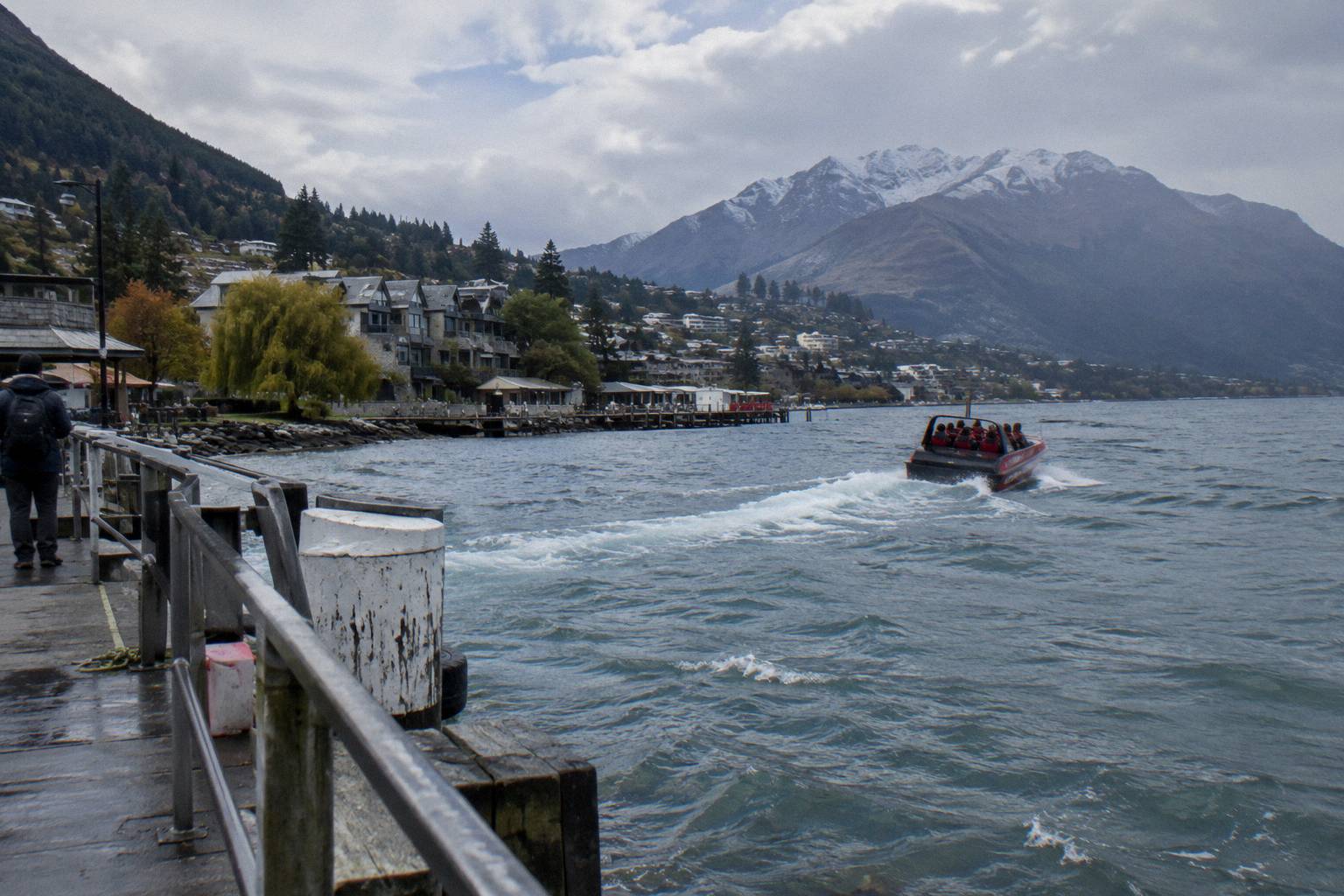
Weather and season shape the decision less than you might fear. Queenstown's climate is real but not disqualifying: mean daily maxima run from 8.2 °C in July to 22.0 °C in January, and rides run year round with weather-permitting language on every listing. KJet does not provide spray jackets, so a waterproof jacket is on you, and winter riders should bring gloves, hat and sunglasses or goggles. The full kit list is in the guide to what to wear on a jet boat ride in Queenstown, and the seasonal detail lives in the piece on winter jet boating on the Kawarau.
What To Ask The Operator Before You Book
Ask three specific questions before paying: does this departure's route on the day reach the stretch of the Kawarau you care about; does the 360 spin feature on this ride; and does this departure leave from the Main Town Pier, the Frankton marina or a wharf kiosk. No operator publishes this detail, so the answers only exist at the source, and every listing here carries free cancellation up to 24 hours if an answer changes your mind.
The checklist below is built from the gaps in the published record, not from generic booking advice. Each item is a place where the published record runs out.
| Question to ask | Why it matters | Who to ask |
|---|---|---|
| Which stretch of the Kawarau does this departure cover? | No operator publishes a route; the waterways are named, the extent is not | The operator, before booking |
| Does this ride include 360 degree spins? | Thunder Jet lists spins on both rides; KJet lists no spin | The operator's listing and FAQ |
| Where exactly does this departure leave from? | KJet runs the Main Town Pier and a roughly 40-minute Frankton marina version; Thunder Jet runs a Steamer Wharf kiosk | The operator, when booking |
| Can we be picked up from our hotel jetty? | KJet says pick-ups from the Rees and Hilton jetties can be requested; Thunder Jet's pickup status is unclear | The operator directly |
| What happens if weather cancels the trip? | Weather-permitting language applies to every listing; rebooking and refund terms sit with the operator | The operator's terms |
The spin question is worth its own line because it is the most concrete difference between the published listings. Thunder Jet's booking pages list full 360 degree spins and commentary for both its rides; KJet's booking page lists the ride, driver and guide, life vests and a safety briefing, with no spin listed. That is a statement about what each page says, not about what each boat does. The deeper comparison, including how the rides differ on the water, is in KJet versus Thunder Jet and the roundup of which rides list 360 spins.
Getting The Gorge And The Jet Boat Into One Day
A realistic one-day plan runs the jet boat from a Queenstown Bay departure point in the morning, then drives State Highway 6 into the gorge for the suspension bridge, the bungy viewing and Gibbston, all on the road the river follows. Book the ride for the morning, keep the afternoon free, and let the published departure times, hourly on the hour from 10am to 6pm at KJet, set the schedule.
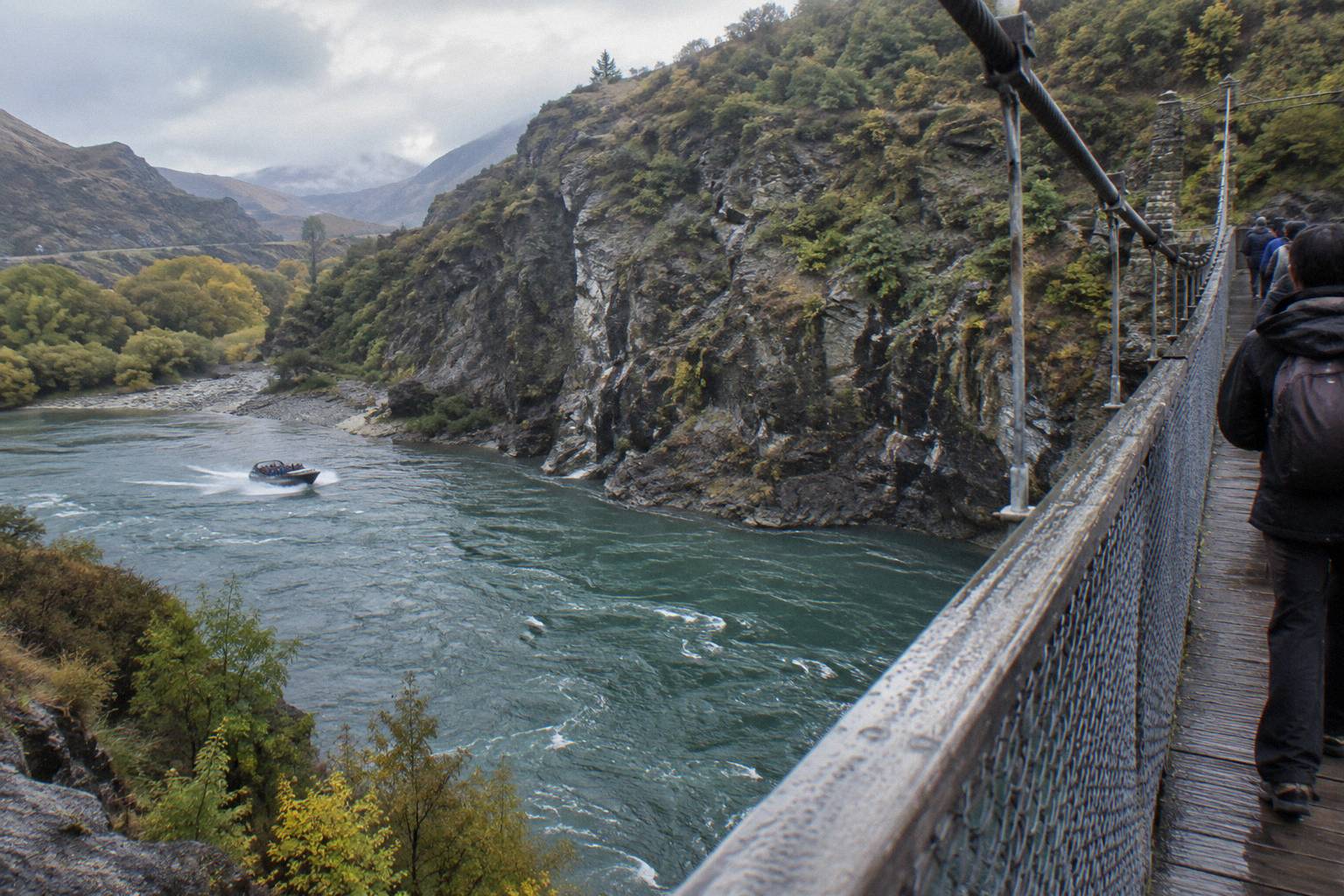
The morning-first order has a practical edge: jet boats run through the day, so an early ride leaves the whole afternoon for the drive, and a ride cancelled for weather can usually be rebooked later the same day rather than lost. The reverse order works too, arriving back in town for a late-afternoon departure, but it leaves no slack if the drive runs long. Weather-permitting is the one clause that can move either plan, and the guide to when weather cancels a KJet ride explains how rebooking works.
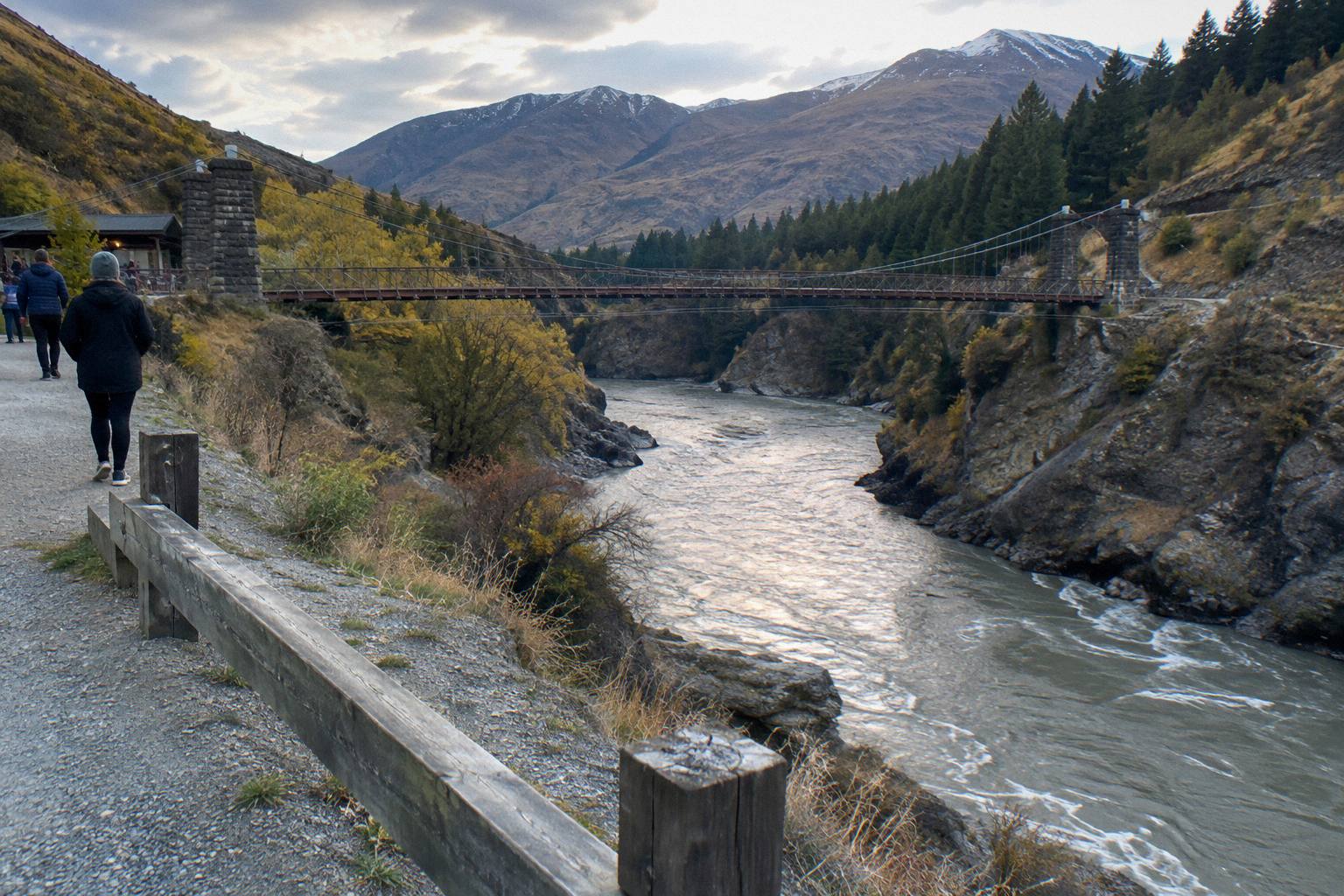
Timing around the seasons matters more for the drive than the ride. Daylight averages 9.2 hours in July against 15.6 hours in December, so a winter gorge drive wants an early start to finish in light, while summer gives you an evening ride option after the drive. For anyone turning the whole waterfront into a day, the planner for a Queenstown waterfront day around a KJet ride sequences the pier, the gardens and the wharf in one loop.
Where Jet Boating On This River Began
Jet boating itself is a New Zealand invention: the Hamilton jet was developed by Sir William Hamilton in the mid-1950s for shallow rivers, and KJet describes itself as the world's first commercial jet boat operator, saying it began in 1958 from the Kawarau. KJet's own account traces an early run over the Kawarau Falls dam in a Hamilton Jet, but no independent confirmation of the "world's first" claim has been found, and Shotover Jet dates itself to 1965.
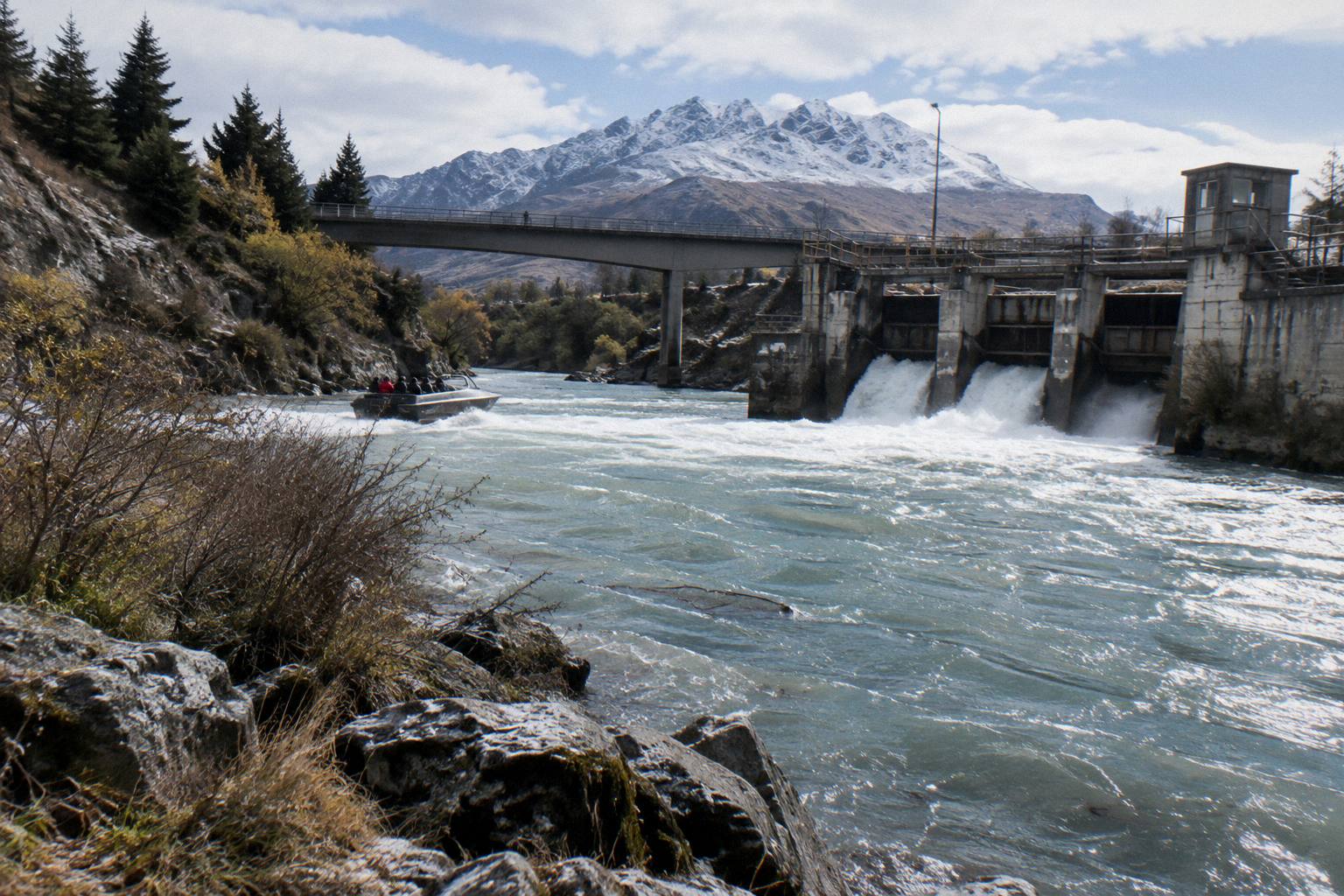
The history matters here for one reason: the Kawarau is not incidental to jet boating, it is one of the rivers where the commercial industry grew up. KJet says its operation started at the Kawarau in 1958 and moved to the Main Town Pier in Queenstown Bay in 1960, extending later onto the Shotover. Whether or not the "world's first" title survives independent scrutiny, the river's role in the story is undisputed by anyone involved. The longer account, including the conflicting origin claims, is in the guide to jet boating in New Zealand and where it began.
For a visitor standing on the Main Town Pier, that heritage is mostly flavour. What you are buying is an hour, or half an hour, on waterways that a licensing regime, a council bylaw and six decades of commercial operation have made routine. The rules say where the speed may happen; the listings say which rivers are named; the rest is between you and the driver. For the operator and regulator records behind those rivers and rules, the pages at Kawarau River Jet Boats stick to the published facts and nothing else.
Common Questions About The Kawarau Gorge And Jet Boats
Does A Jet Boat Go Through The Kawarau Gorge?
No operator publishes a route, so there is no verified yes or no. KJet and Thunder Jet both name the Kawarau River among their waterways, but naming a river does not state which stretch a ride covers. Ask the operator directly before booking.
Which Jet Boat Rides Go On The Kawarau River?
The KJet 60-Minute Jet Boat Ride names Lake Wakatipu, the Kawarau and the Shotover; both Thunder Jet rides name Lake Wakatipu and the Kawarau; and the RealNZ raft trip uses a jet boat leg of about 25 minutes as the transfer on the Kawarau. The Shotover Jet Ride is on the Shotover River, not the Kawarau.
Can You See The Kawarau Gorge Suspension Bridge From A Jet Boat?
No Queenstown jet boat product claims the suspension bridge, which stands 43 m above the river in the gorge stretch reached by road on State Highway 6. It is the site AJ Hackett describes as the world's first commercial bungy jumping operation, and it works as a separate stop or a bungy booking.
Is The RealNZ Trip A Jet Boat Ride?
It is a raft-led trip of about 4.5 hours in which the jet boat leg of about 25 minutes takes you to the rafting put-in, followed by about an hour of rafting on the Kawarau. The jet boat is the transfer, not the headline, but it is the product with the most time on the Kawarau River.
How Fast Can Jet Boats Go On The Kawarau?
The council lifts the 5-knot nearshore limit on the Kawarau from Lake Wakatipu to the Arrow River confluence all year, except a buoyed area near the Zoological Gardens, which is where fast jet boating is lawful. KJet states speeds up to 95 km/h for its own boats; that figure is KJet's and is not applied to any other operator.
Do Jet Boats Run On The Kawarau In Winter?
Yes, KJet says departures run every hour on the hour from 10am to 6pm, 365 days a year, weather permitting, and every listing carries weather-permitting language. KJet does not provide spray jackets, so bring a waterproof jacket, and in winter add gloves, a hat and sunglasses or goggles.